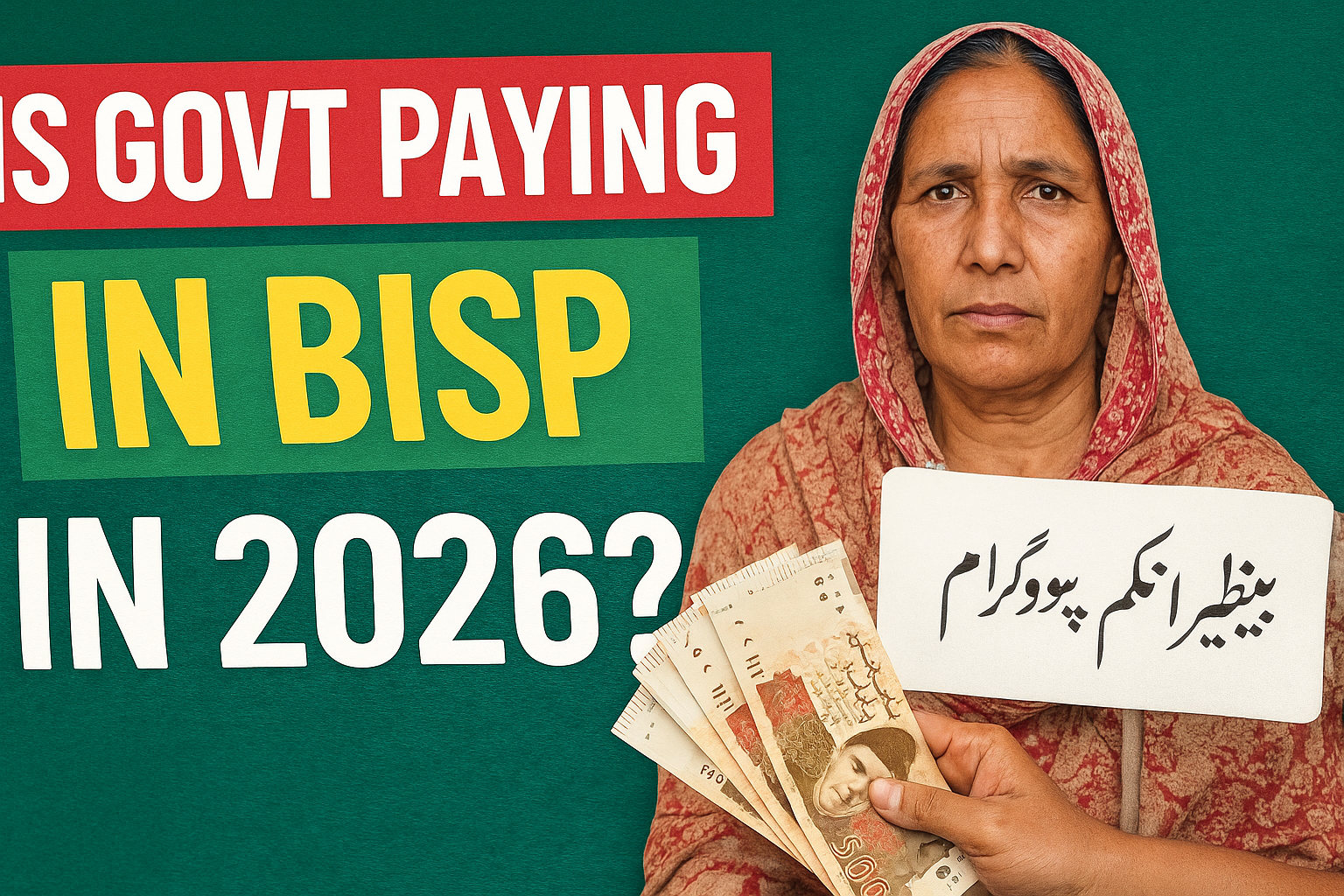
Yes — as of 2025–2026, the government, via BISP, is actively disbursing payments to eligible households. Recent budget allocations and policy updates confirm that BISP remains operational, and the latest quarterly installments have been announced.However, continuing to receive payments depends on having valid registration and meeting updated eligibility criteria — not everyone automatically qualifies. This article outlines what’s new for 2026, who gets paid, and how you can check if you are a recipient.
What’s New in BISP 2025–2026: Expansion & Payment Increases
✅ Extended Coverage to More Regions
According to the 2025–26 federal budget, BISP’s aid coverage has been expanded. New areas — including previously under‑served or remote regions (such as parts of newly merged districts, and in some cases regions like Azad Jammu and Kashmir (AJK) and Gilgit-Baltistan (GB)) — are now included in BISP’s support program.
Increased Payment Amount (as of 2025)
To address rising inflation and cost-of-living pressures, BISP increased its quarterly cash assistance. For 2025–2026, the announced installment per eligible family was raised from Rs 13,500 to Rs 14,500. ers BISP’s regular welfare assistance under the “Kafaalat” scheme.
Who Is Eligible for BISP Payments in 2026?
Not everyone gets BISP funds automatically. The programme aims to support “deserving and low-income households,” and eligibility depends on several factors, updated via periodic surveys. Key eligibility criteria (as of 2025–26) include:
-
A low poverty/means-test score (commonly measured by proxy-means test — PMT — under the national registry system).
-
Household income below a threshold (as defined by BISP).
-
Registration in the database (often via the national registry or survey process).
-
Valid Computerized National Identity Card (CNIC) and updated registration data via the national registry.
-
Not being disqualified by certain asset or income-based disqualifiers (e.g., substantial property ownership, government employment/pension, or other disqualifying conditions) — as per BISP’s means-testing norms.
Also, BISP tends to prioritize vulnerable households — e.g., female-headed households, low-income rural families, families with disabled members or children.
In short — only those who have gone through registration and verification and meet the socio-economic criteria remain eligible.
How Payments Are Being Disbursed in 2025‑26
In recent cycles, BISP payments are being distributed through a more structured and secure system. Key features of the 2025‑26 disbursement mechanism:
-
Biometric verification: Before receiving payment, beneficiaries must verify their identity using fingerprint/biometric check (linked to CNIC and national database). This is designed to prevent duplicate or fraudulent claims.
-
Multiple channels for receiving funds:
-
Designated BISP campsites or payment centers across districts.
-
Bank transfers to partner banks / ATMs in many cases, allowing direct withdrawal rather than relying solely on cash delivery.
-
Mobile-wallet / authorized retail agent options (in some areas) for ease of access.
-
-
SMS and online status updates: Eligible beneficiaries get notified by SMS (usually from code 8171) when funds are released. Also, there is an official portal or method to check your CNIC status for eligibility and payment release.
This system aims to enhance transparency, reduce fraud, and ensure that cash transfers reach rightful recipients.
2026 Reality: Is Government Still “Paying the Public”? — Yes, but With Conditions
From public announcements and recent disbursement cycles, it’s clear that the government is still paying under BISP in 2026 — but only for verified and eligible households. The program remains active following the 2025–26 budget expansion.
However, some households may face issues such as:
-
Payment suspension or removal if their registration data is outdated or failed verification (CNIC expired, NSER data incomplete, or PMT score above threshold). Many previously suspended beneficiaries had payments restored only after re‑verification.
-
Delay in payment disbursement depending on district and verification timetable. Payments are often rolled out in phases across different districts.
-
Need to complete biometric verification or dynamic survey — failure to comply can result in disqualificate government is paying, but you must be officially verified and listed as eligible under BISP’s updated criteria.
How to Check If You Qualify — and If Payment Is Released
If you wonder whether you’ll receive a BISP payment in 2026, here’s what you should do:
-
Check your CNIC via official portal or SMS
-
Use the code 8171: send your 13‑digit CNIC (without dashes) to this number; you’ll get a response about your eligibility/payment status.
-
Alternatively, visit the official BISP / 8171 web portal and enter your CNIC for status check.
-
-
Wait for official SMS confirmation
-
Before each payment cycle, BISP sends SMS to verified beneficiaries indicating payment release and collection points.
-
-
Visit designated payment center / ATM / partner bank
-
Upon receiving SMS, go to the nearest BISP campsite or authorized bank/ATM, bring your original CNIC, and complete biometric verification to collect cash
-
-
Avoid unofficial agents or demands for fees
-
BISP and the government stress that registration and payments are completely free. Any demand for payment or fee is a scam — beneficiaries should report such attempts.
-
-
Ensure your data is updated
-
If there have been changes in household income, assets, or CNIC status, make sure to update information in the National Socio‑Economic Registry (NSER) or BISP’s database to maintain eligibility
-
Common Challenges & What You Should Know — Realistic Expectations
-
Delayed payouts: Because payments are phased by district and verification can take time, some beneficiaries receive funds earlier than others. Don’t assume everyone gets paid at the same time.
-
Verification requirements: Biometric verification, correct CNIC, valid NSER data — missing any of these might block your payment, even if you were previously a regular beneficiary.
-
Fluctuating eligibility: Poverty assessments (PMT scores) and income thresholds can change with economic conditions; meeting criteria today does not guarantee future eligibility.
-
Possible confusion or scams: Some people impersonate BISP staff demanding fees or personal info — only trust official 8171 SMS, portals, or recognized payment centers.
Despite challenges, BISP remains one of Pakistan’s largest social safety nets, and the reforms in 2025–26 aim to enhance its transparency and fairness.
Why BISP Remains Important in 2026 — Social Safety Net Amid Economic Difficulty
With inflation, rising cost of living, and economic instability affecting many households across Pakistan, BISP plays a critical role:
-
Quarterly cash assistance helps low-income and vulnerable families manage essentials like food, utilities, healthcare, and children’s needs.
-
Expansion of coverage means more underprivileged regions — rural, remote, or previously excluded — are now included.
-
Regular payments support female‑headed households, disabled persons, single mothers, and families with little other support — offering a vital safety net.
-
Biometric verification and transparency reforms aim to minimize corruption and ensure fair disbursement to actual deserving households.
Thus, for many in Pakistan — including in cities like Lahore — BISP remains a meaningful source of support in 2026.
Conclusion — What You Should Know About BISP Payments in 2026
-
Yes — as of 2025–2026, the government is paying recipients under BISP. New installments (e.g., Rs 14,500 quarterly) have been announced.
-
Only those with verified registration, valid CNIC, updated socio-economic data, and meeting eligibility criteria receive payments.
-
Payments are disbursed through secure methods: biometric verification, bank transfers, authorized campsites or ATMs, and announced via official SMS or portal.
-
If you’re unsure of your status — check via 8171 (SMS or portal), verify your data, and avoid scams.
-
The program continues to expand, so for genuinely vulnerable households, BISP remains a key social safety net in 2026.
If you like — I can draft a quick checklist you can copy & share with friends/family to check BISP eligibility and payment status in 2026 (with steps + contacts). Do you want me to build that checklist now?